What is zero-click search? A complete 2026 guide
You rank on the first page of Google. Nobody visits your site.
This isn't a glitch. It's the defining dynamic of search in 2026 — and if your reporting still treats organic ranking as a reliable proxy for organic traffic, the numbers stopped making sense some time ago.
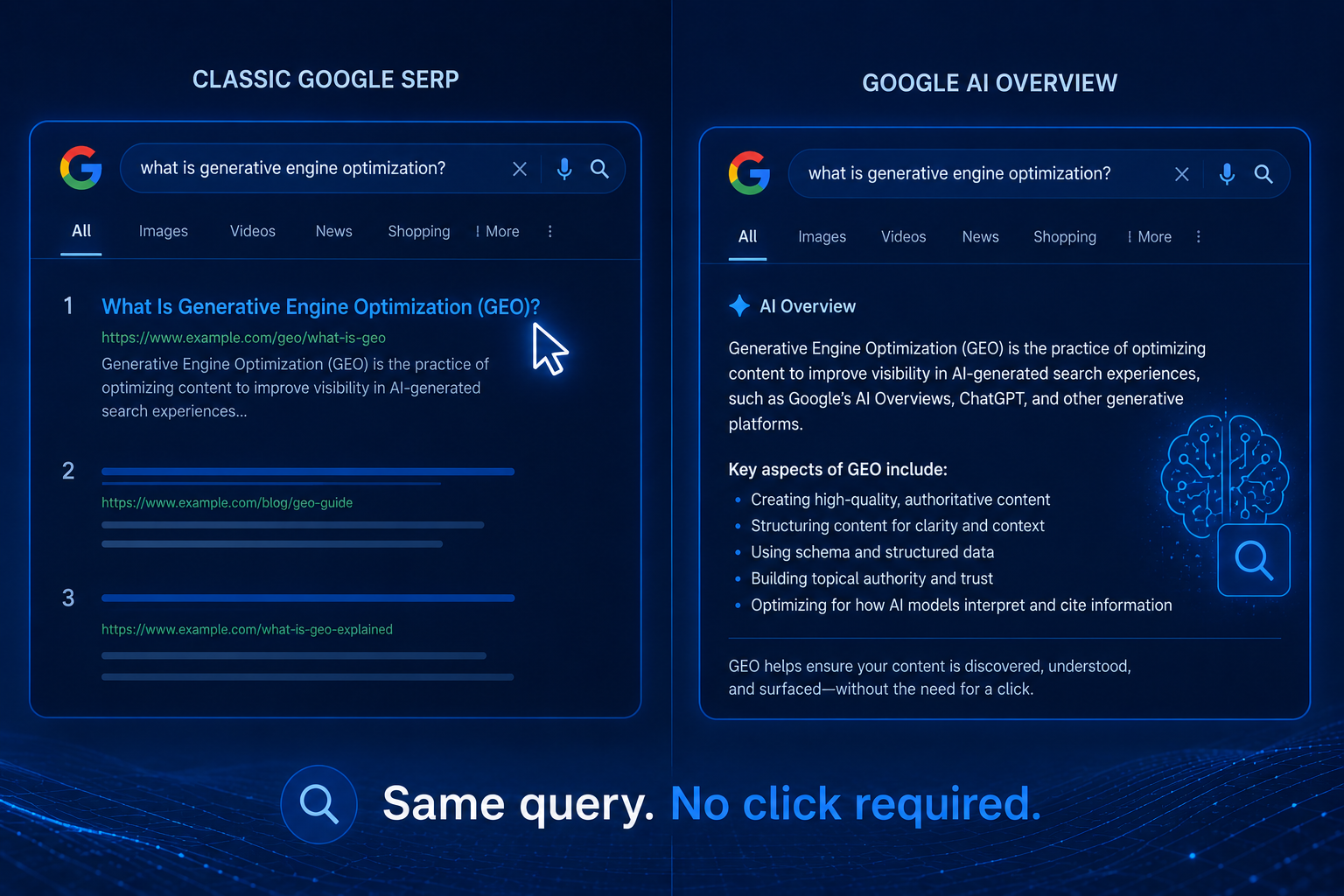
Zero-click search happens when a user's query is answered directly on the search results page, so completely that there is no reason to click anything. It has existed since Google introduced featured snippets in 2014, but it has accelerated dramatically with the rollout and expansion of AI Overviews, AI Mode and now persistent search agents. Understanding what drives it, what it means for content strategy and what to do about it is no longer optional for anyone working in organic search.
This guide covers the mechanics, the data, and the practical response.
What zero-click search means
A zero-click search is any query that ends on the search results page without the user clicking through to a website. The user asked a question; the search engine answered it. Job done — from Google's perspective. From yours, a potential visit never happened.
Zero-click searches are not new. They became a serious concern for content teams around 2019, when Google began aggressively expanding featured snippets, knowledge panels and answer boxes. What changed in 2024 and 2025 was scale: the launch of AI Overviews transformed the featured snippet from an occasional occurrence into a near-universal layer on top of the results.
The difference between a featured snippet and an AI Overview
A featured snippet pulls a passage from a single ranking page and displays it above the results. The source is cited, the format is constrained, and the original page is still just one click away with a visible link.
An AI Overview is something different. It synthesises information from multiple sources into a generated answer, often with supporting links but no single prominent source. It can run to several paragraphs, include lists and tables, and address follow-up angles the user hadn't yet typed. It is designed to be sufficient on its own.
That sufficiency is exactly what drives zero-click behaviour. When an answer is complete, the incentive to click disappears.
The 2026 data: how bad is it?
The short version: worse than most teams have acknowledged, but more nuanced than the headline numbers suggest.
SISTRIX published click-through rate data in March 2026 showing position one CTR had fallen from 27% to 11% in twelve months. That 16-percentage-point drop is the sharpest year-on-year decline in recorded CTR history for the top organic position.
The query-level data is equally stark:
- 60% of all Google queries now end without a click
- 69% of news-related searches result in zero clicks
- 93% of queries made through Google AI Mode end without a click
When an AI Overview specifically appears above the results, the zero-click rate for that SERP jumps to 83%, and the page ranking first loses approximately 58% of the clicks it would otherwise receive.
See the full zero-click statistics for 2026
The nuance the headlines miss
None of the above means traffic has become worthless. Research from First Page Sage shows that visitors arriving via AI-referred sources convert at 4.4 times the rate of traditional organic visitors. The traffic that does make it through is better qualified, more intentional and more commercially valuable than average organic traffic.
The picture, properly framed, is this: fewer visits, higher quality per visit. The problem is that most analytics setups are not measuring visit quality — they are measuring visit volume. That is the reporting gap that most urgently needs closing in 2026. How to measure success when clicks disappear
What is driving zero-click growth in 2026
Three distinct mechanisms are accelerating zero-click behaviour this year. Each matters for a slightly different strategic reason.
1. Google AI Overviews at scale
AI Overviews — powered by Gemini 3.5 Flash as of June 2026 — now appear on a significant and growing share of all Google queries globally. Unlike their 2024 pilot phase, AI Overviews in 2026 are no longer limited to informational queries. They appear on commercial queries, comparison queries and increasingly on navigational ones.
Google's June 2026 core update specifically targeted what it called "information extractability and citation-worthiness" as ranking signals — a clear signal that the search engine is actively building infrastructure for its AI answer layer, not just bolting it on.
2. AI Mode as the default for complex queries
Google's AI Mode — a full-session AI interface that replaces the traditional results page for multi-step or conversational queries — became the default experience for complex searches in mid-2026. Ninety-three percent of AI Mode sessions end without a click to an external site. For users who adopt AI Mode as their primary search interface, the traditional click-through is becoming a deliberate exception rather than an automatic next step.
3. Google information agents: the next frontier
The most significant long-term driver of zero-click behaviour is one that most content teams have not yet grappled with: Google's information agents.
Announced at Google I/O 2026 and available to AI Ultra subscribers from 12 June 2026, information agents operate in the background, monitoring the web continuously on a user's behalf across their priority topics. A user who sets up an agent to track "best project management tools for agencies" will receive synthesised updates from that agent — without ever performing a search.
The implication for content: discovery is increasingly delegated. If your content is not the kind that an AI agent will surface in a background summary, you may not exist in the user's world at all — regardless of where you rank.
What zero-click search means for your content strategy
The temptation in the face of these numbers is to retreat: reduce content investment, focus on brand channels, wait and see. That response misreads the data.
The right response is to shift the goal of content from generating clicks to generating citations.
Being cited within a Google AI Overview drives 120% more organic clicks than appearing on the same search results page without a citation. The mechanism is counterintuitive but consistent: an AI Overview that cites your content signals to users that you are an authoritative source, making the click to your site more intentional and more likely to convert.
This shifts the core question from "how do I rank higher?" to "how do I get cited?". The answers overlap substantially — authority, trust signals and content quality matter in both cases — but the tactical implications diverge in important ways.
Content that survives zero-click search
Not all content is equally vulnerable. Analysis of LLM citation patterns shows that certain content types are cited by AI engines far more often than others:
- Original research and proprietary data: First-party findings that no AI can synthesise from existing web content are consistently cited. Trend and analysis posts attracted LLM citations 78% of the time in one large-scale study; generic educational how-to content sat at 12%.
- First-person experience and case studies: Accounts that are grounded in real experience cannot be replaced by aggregated summaries. AI engines cite them precisely because they contain information that isn't available elsewhere.
- Expert opinion and commentary: A named expert with verifiable credentials saying something substantive provides exactly the kind of EEAT signal AI systems are trained to surface.
- Timely original reporting: Fresh content gets cited approximately 4.3 times more often than content older than three months. Speed and recency matter even more under AI-mediated search than they did under traditional SEO.
7 content types that survive zero-click search
Content that is most at risk
Conversely, some content categories face genuine structural headwinds:
- Generic how-to guides: If the answer can be assembled from publicly available information, an AI Overview will assemble it. Commodity instructional content is exactly what AI Overviews are best at replacing.
- Listicles based on aggregated sources: "Best tools for X" roundups built from other roundups are the clearest example of content an AI can generate on demand.
- Thin informational pages targeting featured snippets: The entire strategy of writing content calibrated to win a featured snippet now feeds directly into AI Overview training data. The snippet win that drove traffic in 2022 may be fuelling a zero-click answer in 2026.
The platform fragmentation problem
One feature of zero-click search in 2026 that many strategies miss: it is not a single ecosystem. Google, ChatGPT, Perplexity and other AI search platforms each operate independent citation networks with minimal overlap.
Research shows that only 11% of domains are cited by both ChatGPT and Perplexity. A brand that has successfully optimised for Google AI Overviews has no statistical guarantee of appearing in ChatGPT Search results, and vice versa.
This matters because users increasingly spread their search behaviour across platforms. A content strategy that focuses exclusively on Google AI Overview eligibility is leaving significant AI search real estate unaddressed.
GEO vs SEO: optimising for citations, not clicks
FAQ
Is zero-click search the same as a featured snippet?
No, though they are related. A featured snippet is a specific format — a box pulled from a single webpage — that predates zero-click as a widespread phenomenon. Zero-click search is the broader behaviour: any query answered on the results page without the user visiting a site. AI Overviews are now the primary driver of zero-click behaviour, having largely superseded featured snippets as the dominant answer-surface on Google.
Does zero-click search mean content marketing is dying?
No. The relationship between content and discovery has changed, but content remains the raw material that AI systems draw on to generate answers. The difference is that the goal has shifted from generating clicks to generating citations. Content that earns AI citations can drive more valuable traffic than traditional ranked content, because AI-referred visitors convert at significantly higher rates than average organic visitors.
Can small sites compete for AI citations?
Yes, and in some ways more easily than for traditional rankings. Research shows that 90% of ChatGPT citations come from pages not ranked in Google's top 20. The citation signal that AI engines respond to is content quality, credibility and specificity — not domain authority in the traditional sense. A specialist publisher with deep, original, well-structured content can outperform a large general-interest site in AI citation frequency.
How do I know if my site is being cited in AI Overviews?
The most reliable method is direct monitoring: run your priority queries in Google AI Mode regularly and check for citations. Tools including the Semrush AI Visibility Toolkit and Ahrefs Brand Radar now track AI citation frequency across major platforms automatically. You should also look for a +120% CTR differential on queries where you hold an AIO citation versus queries where you rank but are not cited. full guide to measuring GEO performance
Will Google's information agents make zero-click search even worse?
For traffic volume, probably yes. Google's information agents, available from June 2026, monitor topics continuously in the background without users needing to search. Discovery becomes delegated, and the explicit search — the moment that generates a click — may never happen. The compensating factor is that content surfaced by agents to high-intent users may drive very high-quality visits when clicks do occur. The priority is ensuring your content is the kind that agents will surface at all.
Conclusion
Zero-click search is not a temporary aberration or a problem Google will walk back. It is the direction search is moving, driven by the same user preference for immediate answers that made featured snippets successful in the first place. AI Overviews, AI Mode and information agents are each expressions of that preference at increasing scale.
The right response is not to abandon content investment. It is to redirect it: from content optimised to rank toward content worthy of citation. Original research, first-person expertise, timely analysis and deeply structured information are the foundations of both.
The click was always a means to an end. The end — reaching the right people at the moment they need what you offer — is still entirely achievable. The path there has changed.
Read next:
- Zero-click search statistics 2026 — the full data set, updated quarterly
- How AI Overviews are driving zero-click growth — the mechanism explained
- 7 content types that survive zero-click search — where to focus your content investment
- How to measure success when clicks disappear — the 5-layer GEO measurement framework
- Zero-click search: myths, facts and what to do — common misconceptions corrected